Why does an AI-built website look AI-generated?
An agent with no direction makes the likeliest choice at every turn: the typeface it has seen most, a purple accent, a hero with two buttons, three cards with icons. Each choice is reasonable on its own. Together they make a site that looks like every other site the same prompt produced. The fix is not a longer prompt or a list of banned fonts. It is a direction settled before any markup: what the site believes, how it moves and what it shows first. The Struq skill writes that direction into a plan and checks it before your agent installs a single block, so the build starts from decisions instead of defaults.
What gives away that a site was made by AI?
These are the patterns people point at when they call a site AI-made. Each one is on the Struq skill’s own list of tells, with its fix beside it. Most come from one habit: the agent fills a slot with what it has seen most, instead of with something this client said. The Struq skill’s check script looks for most of them in your files and keeps failing until they are gone; the rest are judged by eye. The list works without the skill too: read your own page against the left column and apply the right.
| What you see | The fix |
|---|---|
| A small label above every heading, like OUR APPROACH. | The heading carries itself. A new section shows as a hairline, a change of surface or a jump in size. |
| Gradient text, glass panels and a soft glow behind the cards. | Flat colours from one palette. A flat veil over a photo is the only see-through layer. |
| A purple or blue accent that nobody chose. | A palette picked by mood, then sector. Blue only when the brand itself is blue. |
| Three or six cards, each an icon, a heading and two grey lines. | Hairline rows, a list that answers the pointer, an accordion, or one statement. |
| Inter, Poppins or Montserrat everywhere. | A tested pairing that suits the trade, such as Bodoni Moda for fashion. |
| Numbers, reviews and client logos nobody supplied. | Left off the page and listed in the plan, so the client can send the real ones. |
| “Learn more” and “Get started” buttons, some leading nowhere. | Words from the brief, and no button for a shop, booking or contact without a real address. |
What should the agent decide before it writes markup?
Before any file, the Struq skill has your agent write a treatment into STRUQ.md. It opens with the Idea: a point of view in one sentence, what a visitor believes when they leave, never a description of the client. The Unlike line names the site any agent would build for this brief, so the plan can steer away from it. Then a motion language (weight, cut or curtain, picked by the tempo the idea needs, with the reason the other two lost), one motif, a few working words from the client’s trade, a palette, a type pairing, a photo pack and one centerpiece. Last comes the storyboard: every scene in order, each with its reason after the word “because”.
A script checks the plan until it passes. Then the agent stops once, shows the plan in plain words and asks: “Approve? If you have a logo, photos or real numbers, send them now.” Nothing is built before your answer.
What does that plan look like for a real brief?
Below is the plan file the Struq skill wrote for Noir Atelier, a fashion label the agent knew only from a one-line brief. Claude Haiku built the site from it. The file is shown as the agent left it, word for word, including the scenes it cut after looking at the build and the last checklist line it had not yet ticked. Read the Unlike line for the site it chose not to make, and the Assumptions for everything the brief did not give: no prices, no product names, no founder story. Those stay off the page until the label sends the real ones.
STRUQ.md: Noir Atelier
- Brief
- An independent fashion label launching its first collection; a website in English for the label's visitors.
- Hand
- 5asuej
- Idea
- tool: the tailor's chalk line on the cloth is the mark the label leaves; a visitor leaves believing this label makes the one garment a wardrobe needs to hang right, and that the hem is where the work shows.
- Passed over
- Lens season (a year of cloth, a story with no facts behind it); lens number (no figures were given, so the number would be invented).
- Subject
- the cloth hanging and falling -> shown by: the pack photo hero-3 (cloth on a steel rail), with the label's own pieces asked for at the stop; a chalk line drawn in code on the hem.
- Unlike
- the likeliest site is a full-bleed lookbook with a centred serif name, a grid of product cards with prices and a "Shop the collection" button with no destination; Struq's reflexes are a framed photo with the name small beside it and one italic word in every headline. Here the first screen is the cloth on the rail with the name set large in the display face, the chalk line runs down the page, and no button leads anywhere the brief did not name.
- Language
- weight (a slow, settled tempo that suits cloth that hangs and holds; not cut, because a sharp cut reads as sport, not tailoring, and a launch needs long holds; temperament: weighted, the language's default)
- Motif
- aperture: the window the cloth is seen through; it opens around the cloth in the opening, the camera pushes through it in the centrepiece, and the close shows the chalk line ending where the window was.
- Lexicon
- cloth, hang, cut, hem, first collection, make
- Palette
- field-ink-green (ink green field, botanical and literary; light)
- Type
- fashion-contrast: Bodoni Moda + Urbanist (not geometric-modern, because a fashion masthead needs a high-contrast display face, not a geometric one)
- Images
- pack bolt (the client's photos asked for at the stop; until then mood only)
- Centerpiece
- zoom-through: the wool coat falls straight in the photo window and the camera pushes in to the cloth; it is the one moment the site is about the garment itself.
- Tone arc
- paper, paper, paper, paper, paper, ink, paper, paper
- Storyboard
1. Arrival (frame) preloader-stack | lands on: the coat photo growing into the opening; mood only, not their pieces.
2. Opening (loud) hero-poster:column | on screen: the name over one long coat hung in the column | because the first screen must show one garment, not a shop.
3. Scene (quiet) own scene "A first collection" | one sentence, "A first collection, cut to hang." | because one still breath follows the opening.
4. Scene (loud) own scene "The hem" | a pale chalk line straight down a denim twill photo, drawn as you scroll | because the chalk is the mark the label leaves.
5. Scene (quiet) own scene "Made to be worn" | one short line | because a quiet breath comes before the centrepiece.
6. Centerpiece (loud) zoom-through | the falling band of cloth with the camera pushing into it | because one moment about the garment is the film's centre.
7. Close (quiet) idea | ends on a straight chalk line across the close; the footer carries the mail | because the idea is the last word, with no invitation beyond the footer.
- Assumptions
Copy language: English (the brief is in English and the client's market is not stated; mark if otherwise).
Name: Noir Atelier, given in the brief. No wordmark beyond that name.
No door: no address, phone, mail, shop, booking or sign-up link was given. The close ends on the idea and the footer shows no contact. The client must add how visitors reach them (address, mail or shop link).
No product names, prices, sizes, materials, dates, launch day, bio, founder story, stockists or quotes were given. The copy above is drafted mood and sits within the trade words only.
Photos: the pack (bolt) is mood only. No pack photo is presented as the label's own piece, its maker or its workshop. Captions describe the cloth, not the label's work.
Client photos of the collection are needed for the page to show the product (asked at the stop).
- Verify
- filled in at step 7.
Build checklist
- Ticked: 1 Project: Next.js App Router + Tailwind v4; blocks.mjs init printed OK
- Ticked: 2 Treatment and approval: the treatment in STRUQ.md, the plan check at PLAN: PASS; the one stop sent and answered
- Ticked: 3 Canon: the token block and fonts written (canon.mjs palette and type)
- Ticked: 4 Images: images.mjs --brief printed OK; only photos whose alt fits the client
- Ticked: 5 Scenes: frames and the centerpiece installed, every other scene built, composed in app/page.tsx with real copy
- Ticked: 6 Build: npm run build passes
- Ticked: 7 Look: LOOK: PASS on the served build; the art-direction asks answered in .struq/art-direction.md
- Open: 8 Check: check.mjs prints RESULT: PASS
Storyboard changes after art direction
- Scene 5 (the three words) is cut: the trade-glossary reflex with a curtain photo.
- Scene 7 (the still statement) is cut: it broke into one-word rows.
- Opening is the coat photo in the hero's column variant (was the rail).
- Close ends on the straight chalk line; the footer keeps the large name and the launch line.
What changed on the fashion site with the Struq skill?
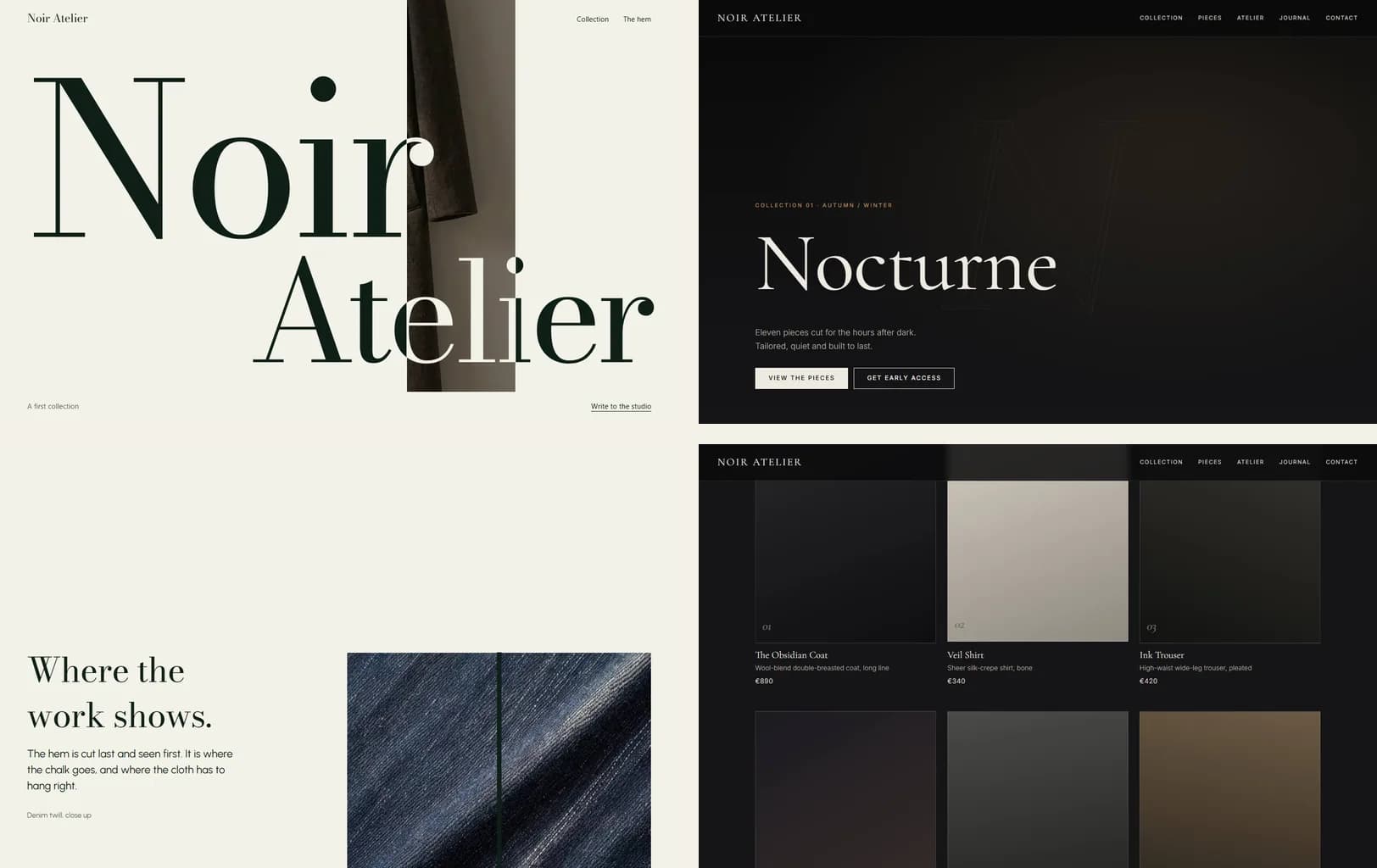
The brief was one line: “A site for Noir Atelier, an independent fashion label launching its first collection.” Claude Haiku, the smallest Claude model, built it twice from that same line, once with the Struq skill and once without it. Both builds got the same answer at the one stop: yes, and a phone number or an email. With the Struq skill (left), the agent set Bodoni Moda against an ink green palette, cut the label’s name with a strip of a hanging coat, and ran a line down a close crop of denim twill, the chalk line its plan made the label’s mark. Without it (right), the same model made a dark template: a small label above a large serif title, two outlined buttons, and numbered product cards with prices the brief never gave.
What changed on the ceramics site with the Struq skill?
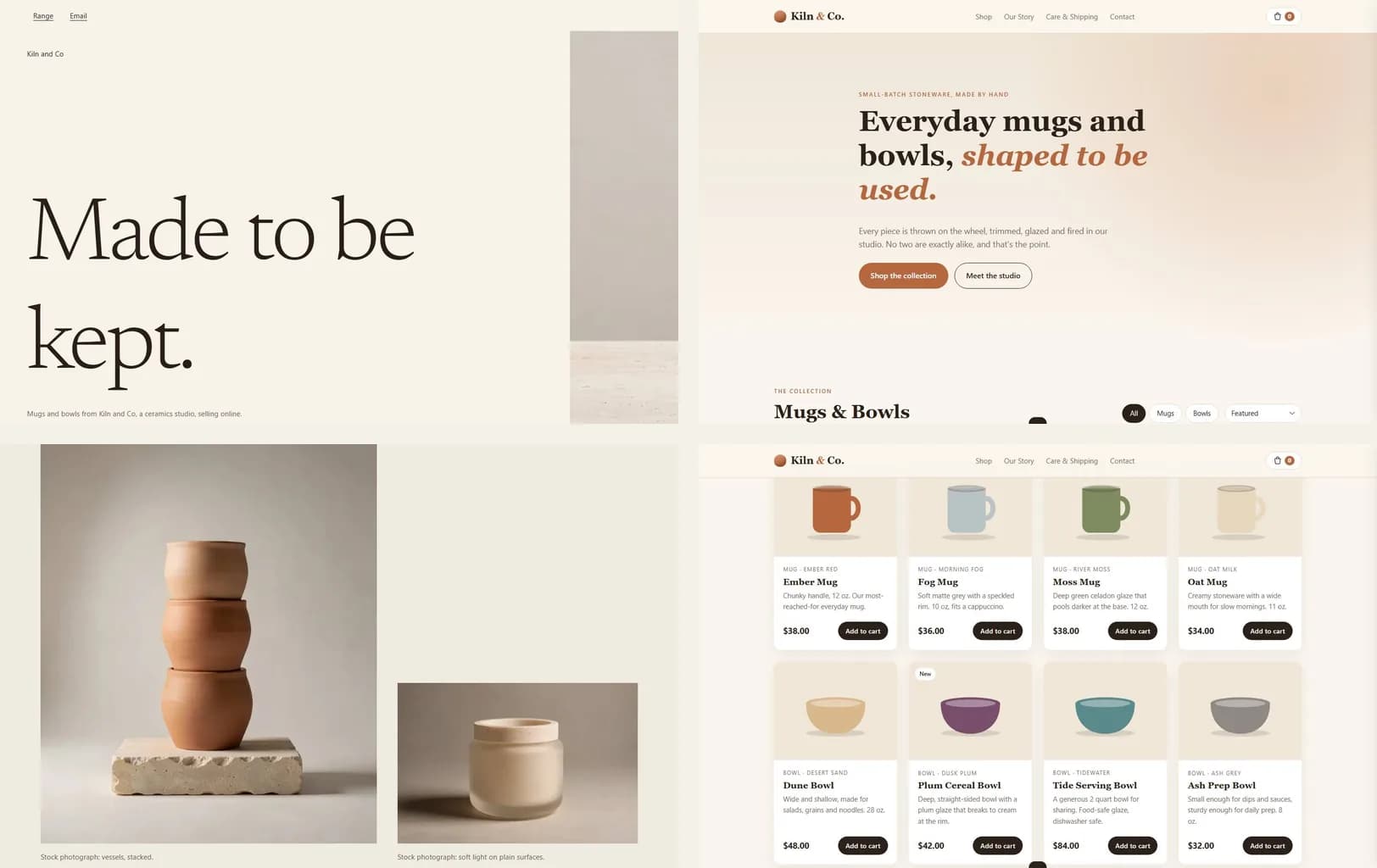
The brief was one line: “A website for Kiln and Co, a ceramics studio that sells mugs and bowls online.” Claude Haiku, the smallest Claude model, built it twice from that same line, once with the Struq skill and once without it, and both builds got the same answer at the one stop. With the Struq skill (left), the site grows from one idea, a bowl you keep: the headline reads “Made to be kept”, set in Newsreader on cream paper, followed by stacked vessels and a jar in soft light. Without it (right), the model made a cream shop template: a small label over the serif headline, an italic accent phrase, rounded buttons, and product cards with names and prices nobody gave it.
How do I get this on my next site?
Install the Struq skill with one command. It finds the AI tools on your machine and installs itself into each; it is free under the MIT licence and needs no account. Then give your agent a brief, one line is enough: in Claude Code, /struq and what the site is for. It writes the plan, stops once for your approval, builds from its blocks and runs its own check. For a site you already have, /struq redesign keeps your brand, copy and components, and /struq audit changes nothing and lists what reads as AI-made, with a fix for each.
The skill page walks through a whole run. If you are choosing between design skills, the comparison guide puts the Struq skill beside five others. The source, the licence and the pairs above are in the repository on GitHub, opens in a new tab, and the installer is @struq/skill on npm, opens in a new tab. Claude Haiku is described on Anthropic’s Haiku page, opens in a new tab.
Questions
Yes. Claude Code, Cursor, Codex and OpenCode are the tested ones. The installer finds the AI tools on your machine and installs the skill into each of them, including Gemini CLI, GitHub Copilot and Windsurf.
Yes. It is free and open source under the MIT licence, and it needs no account. You pay only for your own AI tool, if that has a subscription.
Yes. /struq redesign keeps your brand, copy and components, writes a plan of the page as it will be and stops once for your approval, then swaps in blocks where the page is weakest. /struq audit changes nothing and reports what makes the page look AI-made, with the fixes that change the most.
npx @struq/skill@latest installs the skill into each AI tool it finds: the instructions, the block files and small Node scripts. It needs Node 18 or newer. When your agent builds a site, it adds GSAP, @gsap/react and Lenis to that project and copies in, as files, only the blocks its plan names, plus the header and the menu.
No. It never invents testimonials, logos, stats, awards, prices, addresses, hours or quotes. Whatever the brief did not give stays off the page and is listed under Assumptions in STRUQ.md, so you can send the real ones.